
A model rooted in Maori culture
Te Whare Tapa Whā, which can be translated as “the house with four walls,” was developed in 1984 by Sir Mason Durie, a leading figure in Māori health in New Zealand.
The model uses the wharenui, the traditional meeting house, as its symbol. Its four walls are equal and rest on a solid foundation: the connection to the land, the whenua. Each wall represents a dimension of health.
The New Zealand Ministry of Health summarizes the central idea: if one of the four dimensions is missing or weakened, a person—or a community—can lose their balance and become ill. In other words, health is not merely the absence of physical illness; it depends on the balance of the whole.
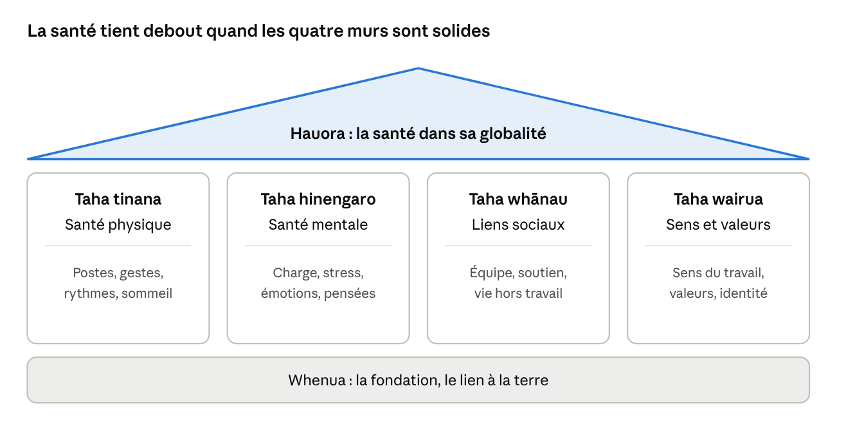
The Four Walls of the House
Te Whare Tapa Whā · four walls, one foundation, interpretation tailored to the workplace
The gray lines offer an interpretation tailored to the workplace. They are not part of the original model.
• Taha tinana, physical health. The body’s ability to develop and function well. According to the Ministry of Health, it cannot be separated from the mind, the spirit, and the family.
• Taha hinengaro, mental health. The ability to communicate, think, and feel. Thoughts, feelings, and emotions are an integral part of the body and spirit.
• Taha whānau, family and relationship health. The ability to belong, care for others, and share within broader social systems.
• Taha wairua, spiritual health. The capacity for faith and connection to something greater than oneself: the vital essence of a person. In the workplace, this can be linked to purpose, values, and identity.
At the core, whenua, the land, forms the foundation upon which everything rests.
A model adopted by the occupational health authority
What makes Te Whare Tapa Whā particularly interesting is its official use in the workplace. WorkSafe, New Zealand’s occupational health and safety authority, refers to it to describe a holistic view of health, or hauora: mental health is presented as interconnected with physical, social, and spiritual health.
This view is supported by law. New Zealand’s Occupational Health and Safety Act of 2015 defines health as “physical and mental.” Employers must provide a work environment free from risks to health—including mental health—to the extent that this is reasonably possible. WorkSafe notes that a work environment detrimental to health can lead to anxiety, depression, and musculoskeletal disorders.
The parallel with Switzerland is striking: here, too, employers must protect the physical and mental health of their employees (Art. 6 LTr). Te Whare Tapa Whā illustrates this requirement simply: a house cannot stand with just one wall.
Four Questions to Assess the Current State of Your Organization
This model lends itself to a simple exercise: looking at each wall of the house, one by one.
Even a hesitant response on just one wall is enough to warrant attention. That is the lesson of this model: the health of a team is not measured wall by wall, but by the balance of the entire house.
Te Whare Tapa Whā is part of Māori culture, and we can draw inspiration from it with respect. But its message is universal: taking care of health at work means taking care of the whole person.
Sources
• New Zealand Ministry of Health, Te Whare Tapa Whā.
• Mental Health Foundation of New Zealand, Te Whare Tapa Whā.
• WorkSafe New Zealand, Why mentally healthy work is a health and safety issue.